
Decent business class offering for a short-haul international route.
Toronto, Canada — My partner and I were on our way to Tokyo by way of Toronto partially as a birthday/anniversary trip and partially as a re-do of a COVID-ruined 2021 trip. After pricing everything out at the time of booking, it was significantly cheaper to take Air Canada from our Atlanta hub to Tokyo with a short layover at Toronto Pearson International than taking a direct flight (like 50+% cheaper).
Having never flown Air Canada, I was not sure what to expect going into the flight, but things started off on a good note when we were upgraded from our original economy ticket to business class about 72 hours before the flight by way of Air Canada’s eUpgrade system (more on that later).
This flight was the first part of a 4-leg journey; you can view associated reviews below:
– YYZ to Tokyo NRT in premium economy
– Tokyo NRT to YYZ in premium economy
– YYZ to ATL return in business class
– Our accommodations at the Hilton Tokyo
Date Flown: 2023 April 15
Departure/Arrival Time: 0555 EDT (originally 0600) – 0827 EDT (originally 0815)
Flight Time: 2h 32m (originally 2h 15m)
Aircraft Type: Bombardier CRJ-900
Fare Class: Business (eUpgraded from Economy)
Elite Status: Aeroplan 25k (via my Chase Aeroplan credit card)
Flight Overview
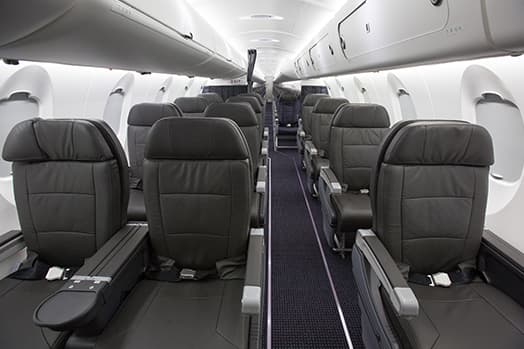
This flight was operated on a Bombardier CRJ-900LR by Air Canada Jazz, the regional subsidiary of Air Canada, flight number AC8948. This version features 12 business class seats in 1-2 configuration and 64 economy seats in 2-2 configuration. This is particularly great for couples in any cabin who can take advantage of the paired seating or families of four in economy who can sit together across an entire row. You can view SeatGuru’s seating map here.

The crew was friendly and efficient. It is notable that many of Air Canada’s crew are bilingual like this one, providing service in both fluent English and French in order to serve the French Canadian population centered particularly around Quebec. It was refreshing to the ears after spending many hours on domestic American carriers.
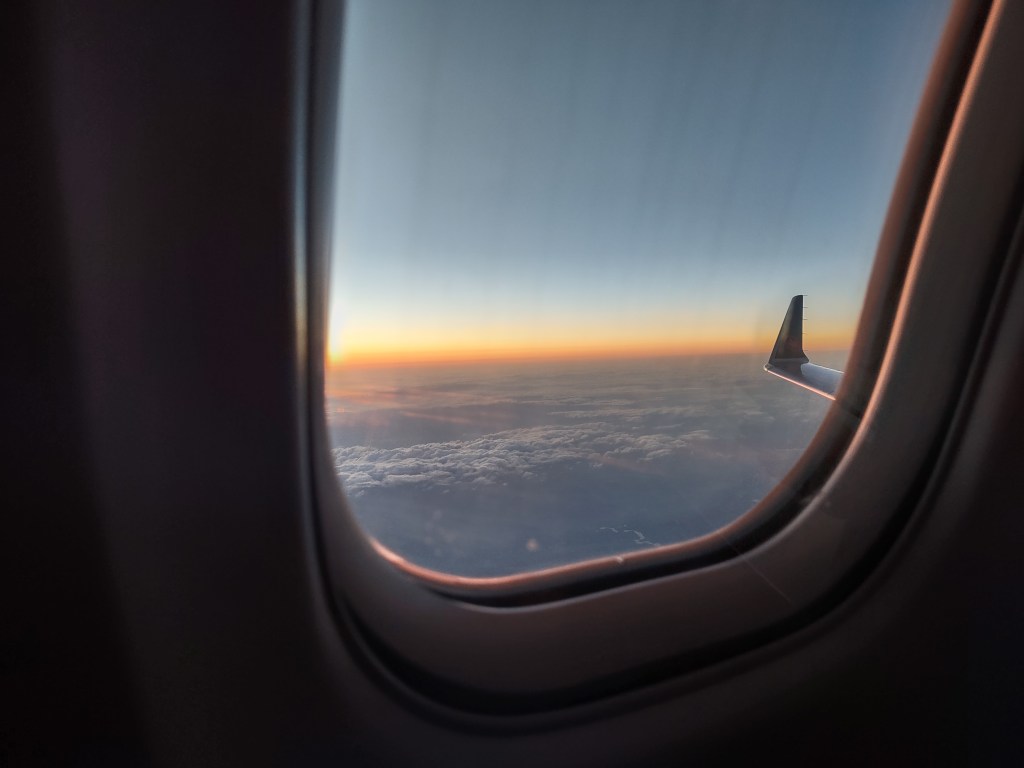
Seat Overview
On this flight, we occupied seats 3D and 3F in the business class cabin. The seat has an advertised pitch of 37 inches and width of 21 inches. For comparison, economy seats have a reported pitch of 31 inches and width of 17 inches (a full 6 inches closer to the seat in front of you and 4 inches skinnier).
Additionally, the paired business class seat have a wider armrest able to accommodate two drinks between them, ensuring less elbow-bumpage with your seatmate and further adding to the roominess on our ride across the border.
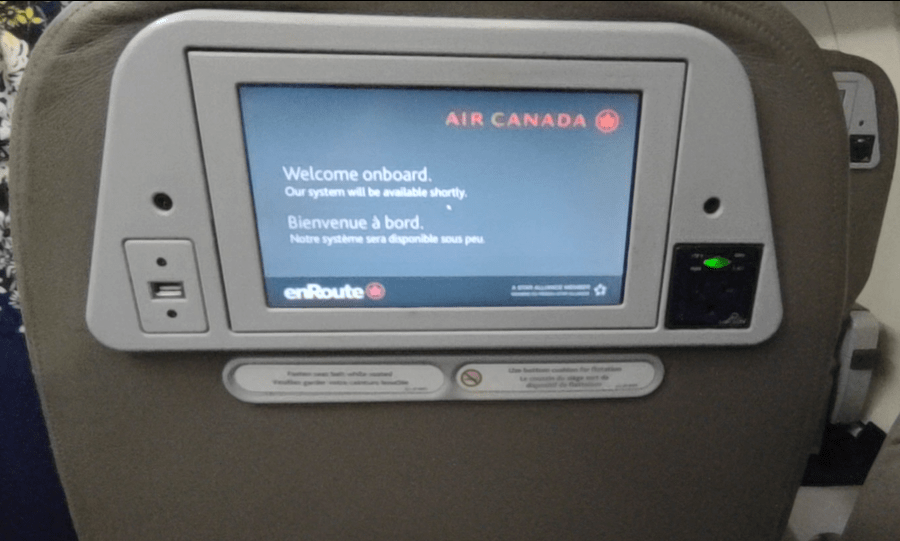
Most seats on this particular CRJ variant have an IFE screen built into the seat in front (the bulkhead seats have their IFE screens mounted on the bulkhead). On this flight, the IFE system was not in-use which I didn’t mind personally since I spent most of it napping to make up for the early-start.
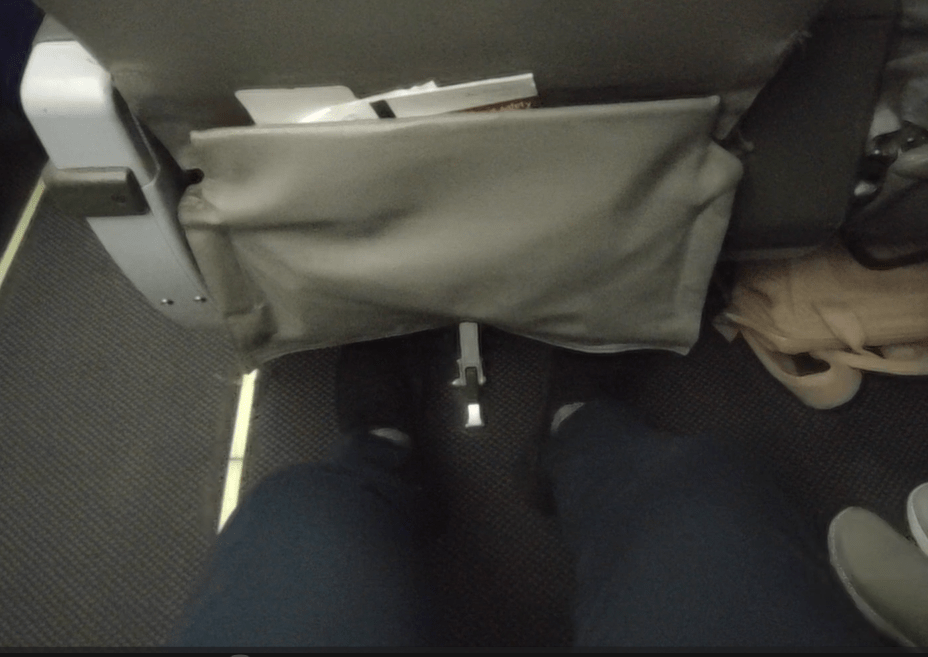
To the left and right of the screen is a USB-A socket and a 100V outlet, respectively, which is handy for charging phones and larger electronic devices at the same time. Additionally, the business class seats have a foot-rest that folds down from under the seat in front which made for a comfy ride when your seat is reclined.
The aisle-side seat tray table deploys from the left-side armrest (this is mirrored for the window-side seat). It is relatively compact so you may have trouble fitting a laptop and a drink on it at the same time, but it was sturdy enough. The seatback pockets had the standard emergency procedures brochure and air-sickness bags.

Meal Service
Business class passengers received a pre-departure water bottle to start. There were no physical menus on this short flight but a digital one was available on the Air Canada app. The official offerings for business class breakfast were either an omelet/sausage plate or French toast, but the sweet option was subbed with pancakes this flight (much to my partner’s dismay).
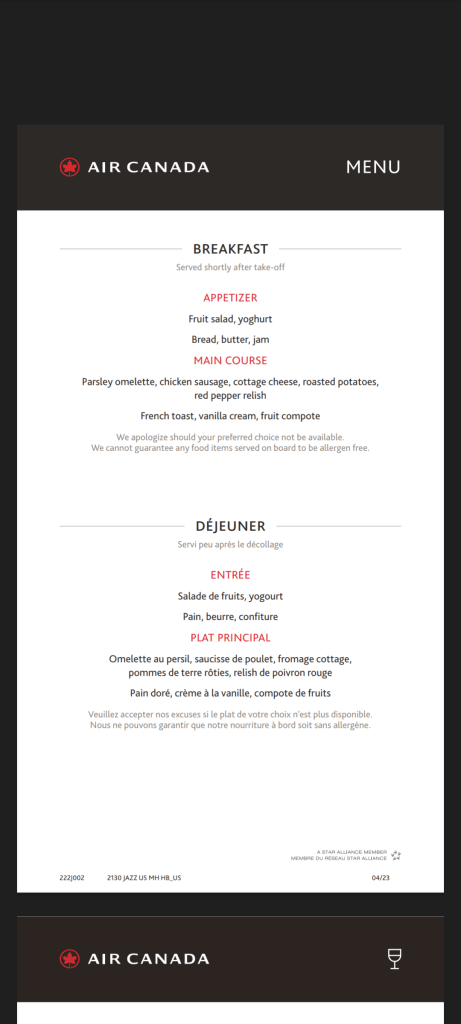

Despite the swap, it was hard to complain about a hot meal and it was still nice overall. The economy breakfast option, for comparison, was a complimentary drink service plus a buy-onboard snack box for those with deeper pockets.
Our cabin attendant took orders shortly after reaching 10,000 ft., and breakfast was served promptly after reaching cruising altitude. It came out hot on one tray with real silverware and ceramic dishware (yay, no more COVID-era plasticware).
The savory option was a solid pick – very filling and tasty. The omelet needed a bit of pepper but was not overdone. The chicken sausage and potatoes were as expected (hard to mess that up), and the overall meal was accented by the well-seasoned red pepper relish and cottage cheese. A warm croissant roll, fresh fruit and strawberry yogurt rounded everything out. I opted for coffee; my partner went for the OJ.

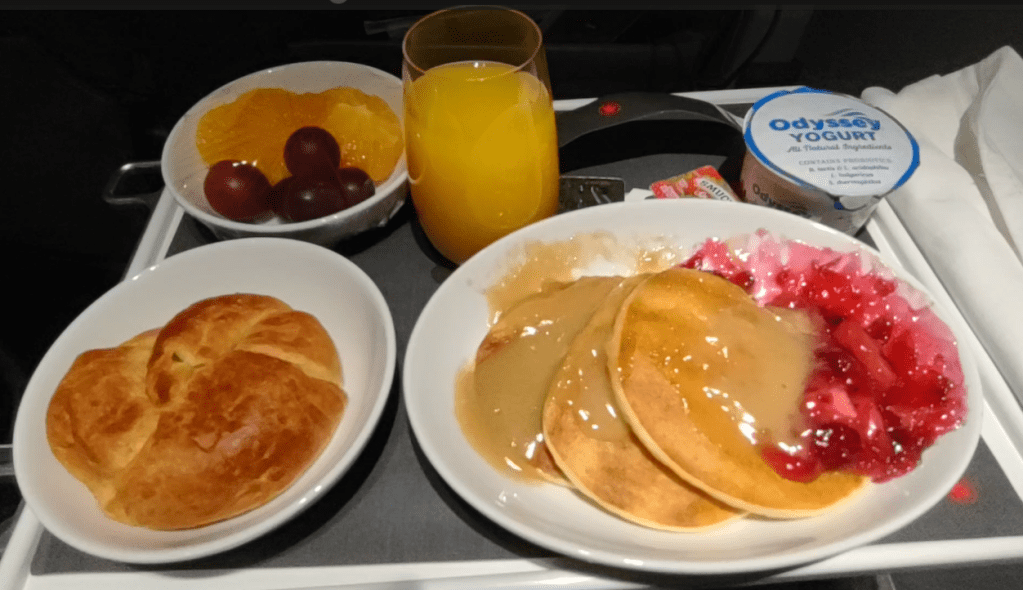
My partner got the sweet option. It was as expected; the pancake I sampled was definitely a pancake. Definitely for those with a sweet tooth. The berry compote was a nice tart addition. Overall a solid meal service for a North American carrier despite the short flight time, well done.
How We Booked and Got Upgraded
This itinerary (ATL-YYZ-NRT roundtrip) was originally booked around September 2022 on a mixed cabin ticket (Economy ATL-YYZ and Premium Economy YYZ-NRT) for $1250.14 per person after taxes and fees.
Air Canada Aeroplan elites receive a certain number of “eUpgrade” credits annually, based on their level of status, that can be applied towards flight upgrades. Applying eUpgrade credits towards an upgrade does not always guarantee an upgrade, but they put your name on the list for consideration based on availability, number of elites on that particular route, those elites’ statuses, etc. You can learn more about the Aeroplan program and the eUpgrade process here.
At the time of this post, I hold Aeroplan 25K elite status by holding a Chase Aeroplan credit card (a benefit for the first two years of card membership). It was through this eUpgrade process that my partner and I were cleared up to business class on this particular flight. It was a nice way to start a fantastic trip back to Japan.
Chase Aeroplan Credit Card
The Chase Aeroplan credit card is an interesting offering for US-based customers who are interested in flying the Canadian flag-carrier. Among various benefits, it offers potentially up to 2 years of entry level Aeroplan 25K elite status with a spend pathway to maintain status or reach the next level, first bag free on Air Canada flights and no foreign transaction fees.
At the time I applied there was a sign-up bonus of 70,000 Aeroplan points, but at the time of this post there is public offer for up to 100,000 points after a certain amount of spend. Based on The Points Guy’s valuation of Aeroplan points, this bonus could potentially be worth $1500 in Air Canada spending. If you are interested in this credit card and want to learn more, you can visit the official application page here.
 Bun World Traveler
Flight reviews are popular because they offer trustworthy and detailed insights into the airline and flight experience, enabling travelers to make informed choices, compare options, and prepare for their journeys. These reviews also serve as a platform for passengers to share recommendations and grievances, influence booking decisions, and hold airlines accountable for service quality, fostering transparency and improving the overall air travel industry.
LikeLiked by 1 person